Settings
 Fast Delivery
 Free Shipping
 Incoterms
 Payment Types


 Marketplace Product


Learn How Resistive Three-Phase Load Banks Speed Testing and Reduce Uncertainty
Testing three-phase power, with three line-to-line voltages, three line currents, three powers, and three line phases, can be enigmatic at best. Voltages and currents interact, especially when load impedances are unknown. This is where a three-phase resistive load bank can simplify your testing (Figure 1).
 Figure 1 : Three-phase testing, complex in its own right, requires known load impedances to separate power-source problems from load problems. (Image source: Art Pini)
Testing a three-phase power source involves measuring the line voltages, line currents, and the phase between them, as well as the power contribution of each phase, which should be equal in a balanced system. The normal operating load in a three-phase system with both resistive and reactive components may adversely affect power-source operation, resulting in phase shifts between voltage and current that reduce the power factor and can complicate testing by increasing losses and unbalancing the phases.
A load bank is helpful for greater predictability. This device provides a controlled, reproducible electrical load for testing and validating power system sources, including generators, uninterruptible power supplies (UPSs), and solar or wind power systems. Resistive loads are the most common because a resistor does not alter the phase relationship between the current through it and the voltage across it, resulting in an ideal power factor of one. Power systems operating with power factors between 0.95 and 1 are ideal; those with power factors below 0.95 are suspect.
The load bank replaces the normal operating load. Its purely resistive load elements simulate ideal electrical loads and establish a controlled-impedance environment, enabling testing of the capacity, efficiency, and reliability of power systems under various conditions and helping to isolate generator- and load-dependent faults.
Selecting a suitable resistive load bank
If you need a resistive load bank, look for versatility, a user-friendly interface, robust software support, effective cooling, safety and protection features, and a compact form factor (we all know how quickly test areas can get crowded).
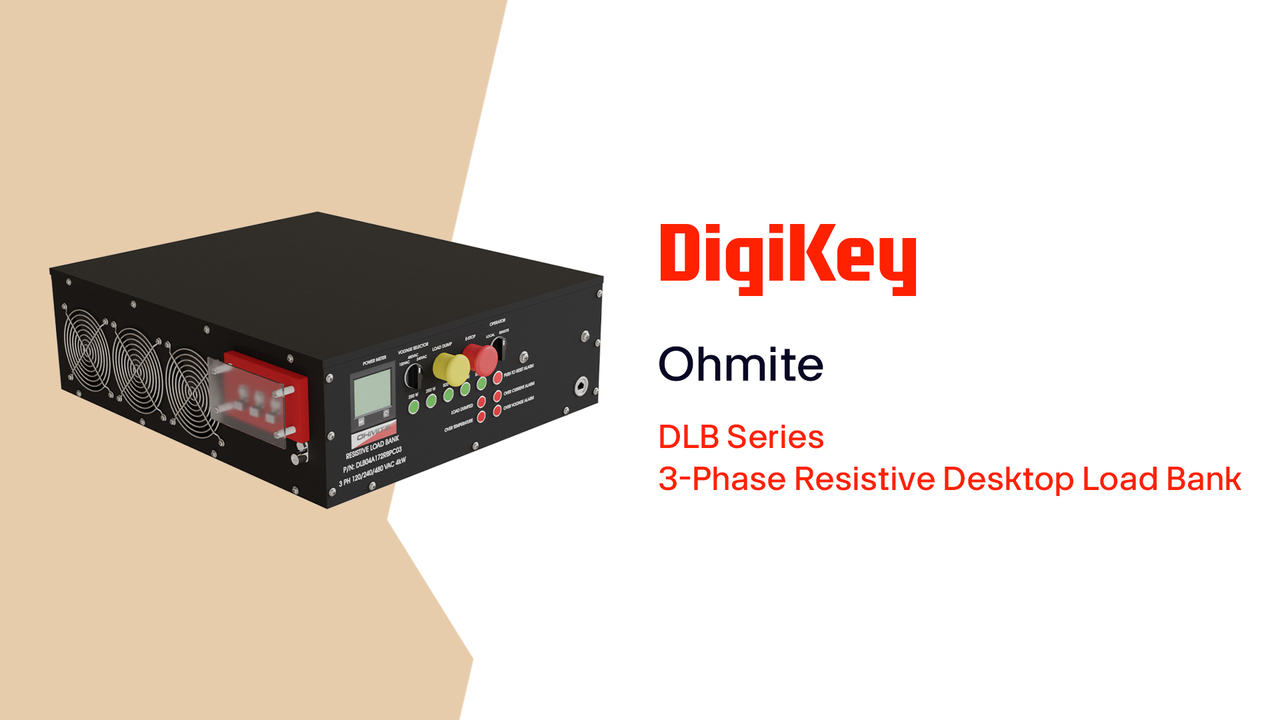
A good option is Ohmite’s DLB series three-phase load bank (Figure 2). This series supports power-source testing across a variety of applications.
 Figure 2: The DLB series benchtop three-phase resistive load bank supports power-source testing across a variety of applications. (Image source: Ohmite)
The DLB series resistive load bank is a benchtop instrument designed for use with 120, 240, or 480 volt AC (VAC) three-phase buses. It is air-cooled for efficient heat dissipation, uses a delta configuration, and can handle a maximum load of 4 kilowatts (kW) (Table 1).
 Table 1: Shown are the available voltage and power configurations of the DLB series resistive load. (Table source: Ohmite)
The load's power levels are selectable, so the line currents depend on the applied voltages. The power level describes the total power contributions of all three phases.
A look at the front panel (Figure 3) reveals a range of functional settings, safety indicators, and controls.
 Figure 3 : Shown are the front-panel display functions of a load bank that allow voltage and power selection and features that ensure safe and efficient operation. (Image source: Ohmite)
The operating voltage is selected via a front-panel switch, while the load power is set using cumulative selection pushbuttons with a resolution of 250 watts.
Warning lights indicate fault conditions of overvoltage, overcurrent, and overtemperature. If a fault occurs, the appropriate warning light will illuminate, and all loads will be shut off to prevent damage. Additionally, the operator can disconnect the load using the load dump, which leaves the cooling fans running, or using the emergency stop button, which disconnects the load and shuts down the fans.
The load's operation can be monitored using the built-in power meter, which reads the voltage, current, power, and frequency of the connected power source.
Input connections from the lines to the load are made using aluminum set-screw lugs that accept wire sizes from 14 to 4 AWG.
If you need a computer interface for remote operation, an optional Ethernet communications port enables control via widely used instrument control software, such as LabVIEW, or custom user software.
The DLB series load is sized for benchtop use with a footprint of 24.4 × 21.7 × 7.7 inches (in.) (620 × 550 × 195 millimeters (mm)).
The DLB series is available in two models that differ only in their auxiliary voltage output to other test instruments: the DLB04A172RBPC03 provides 120 VAC, while the DLB04A172RBPC04 provides 240 VAC.
Conclusion
The Ohmite DLB series three-phase resistive load bank is a versatile instrument for testing and qualifying a variety of three-phase power sources, generators, and backup systems. The series supports high-performance power systems by enabling you to replicate real-world load profiles in critical systems, ensuring reliability and quality.
About this author

Arthur (Art) Pini is a contributing author at DigiKey. He has a Bachelor of Electrical Engineering degree from City College of New York and a Master of Electrical Engineering degree from the City University of New York. He has over 50 years experience in electronics and has worked in key engineering and marketing roles at Teledyne LeCroy, Summation, Wavetek, and Nicolet Scientific. He has interests in measurement technology and extensive experience with oscilloscopes, spectrum analyzers, arbitrary waveform generators, digitizers, and power meters.

Have questions or comments? Continue the conversation on TechForum, DigiKey's online community and technical resource.
Visit TechForumMore Blogs from this Author