


 Settings
 Fast Delivery
 Free Shipping
 Incoterms
 Payment Types


 Marketplace Product

Miniature Sensors Hold Promise for Speeding Disease Diagnosis
Contributed By Electronic Products
2015-02-05
Ebola, the plague of a handful of African nations, conjures up fear globally and has scientific, political, humane, and even technology ramifications. People have questioned drastic measures like closing our boarders and placing many people in quarantine, but what if a sensing device could detect an outbreak of disease fast and in the field before it becomes a crisis? Recent developments in sensor technology are actually getting us closer than you might think to that reality.
The University of Limerick in Ireland recently reported in Nature Materials Journal,¹ that they are on the way to solve the main challenge to using sensors for testing just one molecule for diagnosis. The benefits of testing one molecule include low cost and the ability to perform such tests rapidly in the field. Up until now, however, when a single molecule under test is placed in an electrical sensor, sensor noise interferes with achieving a pure test of the molecule’s properties.
The University’s researchers have achieved a breakthrough using the concept of distance. They are able to slightly separate the molecule and sensor, maintaining a distance that ensures accurate analysis but adequately deals with noise. By adding silicone oil to the molecule under test and placing the mixture on an atom-thick alkanes layer, molecules move across the surface of the sensor slowly, and alkanes maintain the necessary distance. While not yet available in the field, the technology is promising for the detection of diseases such as HIV, the common cold, and perhaps, even Ebola.
Many other research programs are also currently underway, using sensors for medical diagnostics. For example, Google X is researching using magnetic nanoparticles and wearable sensors for disease detection. The concept involves nanoparticles that circulate in the blood and attach themselves to a wide range of diseased cells to detect cancer, sodium levels, plaques, and more. The devices are worn on the body and detect the nanoparticles and report findings to healthcare professionals. The project, however, is still approximately five to seven years from commercialization.
Google has even designed contact lenses that have a wireless chip and a miniature glucose sensor embedded between two layers of soft contact lens material to help diabetics try to keep blood sugar levels under control.
Nanoelectronic devices (e.g., carbon nanotubes, graphene, and more) are being explored for a variety of sensing applications for both liquid and gaseous materials. In particular, nanotechnology shows promise for chemical-vapor sensing; one advantage of nanomaterials here is that they are not subject to interference from solvents typically employed in liquid-based detection. The most common sensing mechanisms under development for nanoelectronic sensing rely on detection of charges. Charge transfer between the adsorbed material and the nanomaterial changes the surface charge density, altering the conductance of the sensors. Unfortunately, up until recently nanoelectronic vapor sensors have been exhibiting response times that are too slow for many practical applications.
However, that may soon be changing: a wearable vapor sensor is under development at the University of Michigan that is designed to overcome this limitation. The researcher’s approach utilizes a graphene field-effect transistor (GrFET) as a high-frequency (greater than 100 kHz) mixer with surface-adsorbed molecules functioning as an oscillating gate. The oscillating molecular dipole—excited by AC-driving voltage—induces a conductance modulation in the graphene channel; this conductance is frequency mixed with the AC excitation generating a heterodyne mixing current. The system is described in the paper, “Graphene nanoelectronic heterodyne sensor for rapid and sensitive vapour detection,” published in Nature Communications.² This technique is said to result in extremely fast response times of tenths of a second, as opposed to the tens or hundreds of seconds typical in existing technology. The prototype also is said to deliver high sensitivity (down to about 1 ppb).
Nanotechnology sensors such as that being developed by the University of Michigan will be able to detect airborne chemicals either exhaled or released through the skin. Indeed, the goal of the Michigan scientists is to create the first wearable to pick up a broad array of chemical, rather than physical, attributes. U-M researchers are working with the National Science Foundation’s Innovation Corps program to move the device from the lab to the marketplace to offer continuous disease monitoring. The wearable sensor is expected to be able to detect a broad array of chemicals, including nitric oxide and oxygen, abnormal levels of which are present in high blood pressure, anemia, or lung-disease patients. The researchers claim that the device under development is faster, smaller, and more reliable than existing technologies, which are also often too large to be considered for wearables.
The technology works when the nanoelectronic-grapheme-vapor sensors are embedded in a microgas-chromatography system. The entire system can be integrated on a single chip with low-power operation, and embedded in a badge-sized device that can be worn on the body.
Available sensors used in diagnostic applications
Innovative packaging is going to be an essential part of developing wearable or disposable diagnostic sensors. Freescale Semiconductor, for example, has developed a low-cost, high-volume, miniature-pressure-sensor package—Freescale’s Chip Pak—which is well-suited as a sub-module component or a disposable unit. The Freescale MPX2300DT1 High-Volume Pressure Sensor (Figure 1) is used in medical-patient monitoring including pressure-catheter applications and in invasive blood-pressure monitors. This new chip-carrier package uses Freescale Semiconductor’s unique sensor die that features piezoresistive technology and on-chip, thin-film temperature compensation and calibration.
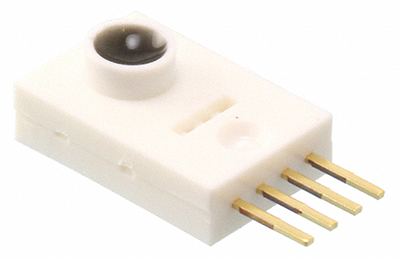
Figure 1: The Freescale MPX2300DT1 device features integrated temperature compensation and calibration, polysulfone case material, and has a low-cost easy-to-use tape-and-reel.
A silicone dielectric gel covers the silicon piezoresistive-sensing element. The gel is said to be a nontoxic, nonallergenic elastomer system meeting all USP Biological Testing Class V requirements. The properties of the gel allow it to transmit pressure uniformly to the diaphragm surface while isolating the internal electrical connections from the corrosive effects of fluids, such as saline solution. The gel provides electrical isolation sufficient to withstand defibrillation testing, as specified in the proposed Association for the Advancement of Medical Instrumentation (AAMI) Standard for blood-pressure transducers. Biomedically approved opaque filler in the gel prevents bright operating-room lights from affecting the performance of the sensor.
New to the industry is the Silicon Labs Biometric EXP evaluation board (Figure 2), a hardware plug-in card for EFM32 Starter Kits (STK’s). The Biometric-EXP demonstrates and evaluates biometric applications of the company’s Si7013 humidity and temperature sensor and Si1146 proximity/UV/ambient-light sensor, capable of monitoring pulse rate and oxygen saturation (SpO2). In addition to the Silicon Labs sensors, the Biometric-EXP EVB contains a Silicon Labs’ TS3310 boost DC-DC converter.
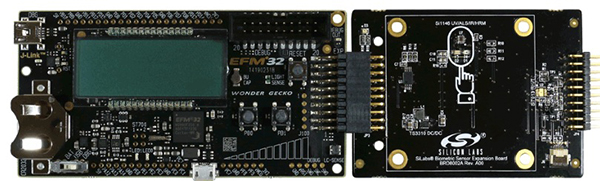
Figure 2: An EFM32 Wonder Gecko STK (Left) connected to a Biometric-EXP (Right).
The software, available for download, is capable of displaying humidity, temperature, UV, pulse rate, and SpO2 readings on a Wonder Gecko STK display. In addition to the two sensors, features include a 6-pin ribbon-cable connector for attaching a wrist-based heart-rate monitor EVB (ordered separately) and 20-pin expansion header and battery operation with low power for long battery life. Demonstration software source code is also available. USB debug mode allows HRM and SpO2 samples to be transferred to a PC and Windows GUI in order to visualize pulse signals and to record samples from USB debug mode.
Custom Piezo film sensors such as the 1004308 Piezo Film Design Kit (no longer available) from Measurement Specialties (Figure 3) have applications in medical diagnostics, monitoring, pulse counting, fetal heart monitoring, apnea monitoring, anesthesia monitoring, respiratory air flow, sleep disorder, and pacemaker activity measurement.
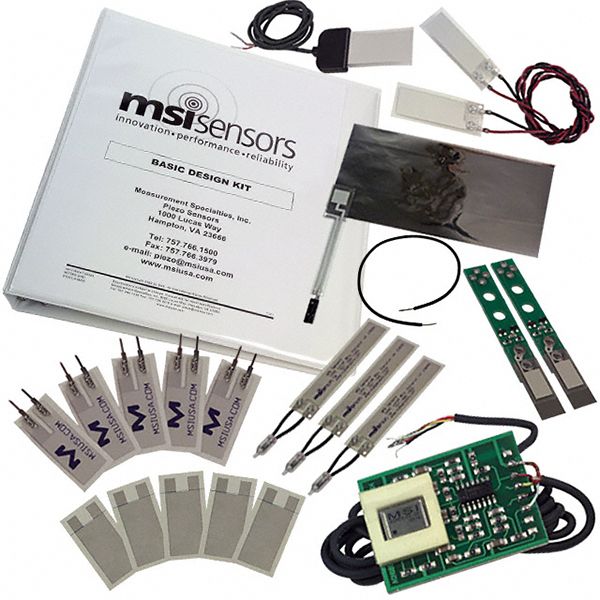
Figure 3: The Measurement Specialties Piezo Film Basic Design Kit includes typical applications, datasheets for all piezo products, a technical manual, interface circuits and samples of film, cable, switches, flickers, and accelerometers.
For specialized medical applications, thicker films, and non-standard shapes for high sensitivity are necessary, which are possible with the wide range of films available from Measurement Specialties. Additional stacking options are available on a custom basis for parallel-wired configurations, where elements of film are laminated and wired to give a higher capacitance per unit of surface area. This option can also be used in order to create a shielded transducer or an acceleration-canceling device.
More biosensor applications
Today, heart disease and pneumonia detection in children are just two of the growing applications that are dramatically benefiting from biosensor platforms. Heart disease alone kills more than 17.5 million annually. In this case, the biosensors are used as rapid-screening tools to detect early-stage disease biomarkers and classify the patient’s condition. The result of early detection should have major impact on reducing the number of deaths, as heart disease is often not found until it causes a fatal event.
Sensors also are currently reducing analysis time by integrating several clinical assays into a single, portable device called a lab-on-a-chip (LOC). For example, researchers collaborating in the Departments of Electrical and Computer Engineering and Chemical and Biological Engineering at Colorado State University have developed a multi-analyte (substance that is analyzed) optoelectronic-sensing chip, which features an integrated photodetector array and leverages existing semiconductor fabrication technology. The waveguides, light source, photodetectors, binding regions, and sample delivery systems can be integrated onto a single silicon CMOS microchip making this a microfluidic sensing LOC. In contrast to typical gene microarray techniques utilizing fluorescence to detect binding events, this technology is capable of outputting data directly in digital format, as conventional IC elements may be incorporated into the chip.
As we have discussed previously, the future of diagnostics lies in wearable, embedded electronic devices based on advanced sensor technology. These devices, which could take the form of fitness-trackers and watches, could be able to detect diseases such as diabetes and cancer from the airborne organic compounds expelled from our bodies. The result would be nothing short of a revolution in medical diagnosis and treatment.
For more information about the parts discussed in this article, use the links provided to access product pages on the DigiKey website.
References
- Nature Materials Journal 17 August 2014 Nanoelectrical analysis of single molecules and atomic-scale materials at the solid/liquid interface Peter Nirmalraj, Damien Thompson, Agustín Molina-Ontoria, Marilyne Sousa, Nazario Martín, Bernd Gotsmann& Heike Riel.
- Graphene nanoelectronic heterodyne sensor for rapid and sensitive vapour detection. Girish S. Kulkarni, Karthik Reddy, Zhaohui Zhong & Xudong Fan Nature Communications 07 July 2014.
Disclaimer: The opinions, beliefs, and viewpoints expressed by the various authors and/or forum participants on this website do not necessarily reflect the opinions, beliefs, and viewpoints of DigiKey or official policies of DigiKey.







 United Kingdom